What Is Metal Mesh Laminated Glass? A Specifier’s Guide for UAE Interiors
What Is Metal Mesh Laminated Glass? A Specifier's Guide for UAE Interiors
You've picked a copper or steel weave for a lobby, partition or lift interior. The client loves the metallic glow. Then the questions start. Will it pass safety review? Is it the same as wire glass? What does the metal do to light, privacy and colour once it's sealed in glass?
Metal mesh glass answers most of these questions, and it raises a few new ones. This guide covers what the product is, where it works and what UAE design teams should check before specifying it. It's written for interior designers, architects, fit-out contractors, interior contractors, general contractors and technical services companies.
Key Takeaways
- Metal mesh laminated glass sandwiches woven metal wire between glass layers, giving a metallic finish with laminated-glass behaviour.
- The UAE Fire & Life Safety Code requires building glass to be tested to BS EN 12600, per Element.
- Decorative metal mesh glass is not the same as traditional wire glass, and it isn't fire-rated by default.
- Ask for test reports on the exact build, not the catalogue sample.
What: Decorative laminated glass with woven metal mesh between glass layers Also called: Metal mesh glass, metal glass, metal wire mesh glass Not the same as: Traditional wire glass (rolled glass with a wire grid) Finishes: Gold, steel and copper mesh (GLAZART MetalArt) UAE rule: Building glass tested and classified to BS EN 12600 Made: To order in Dubai by GLAZART
What Is Metal Mesh Laminated Glass, and Is It the Same as Wire Glass?
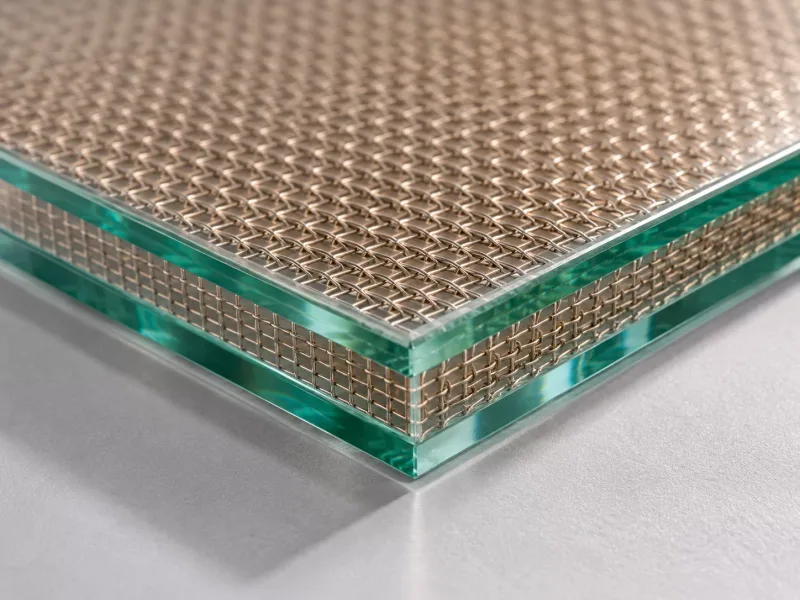
Metal mesh laminated glass is a decorative laminate. A woven metal mesh is encapsulated between two or more panes of glass and held by an interlayer. "Metal mesh glass", "metal glass", "metal wire mesh glass" and "metal mesh laminated glass" are used interchangeably in the trade. They describe the same construction.
"Wire glass" is a different thing. Traditional wired glass is rolled glass with a plain wire grid set into it, and it was mainly used for fire-door vision panels. Decorative metal mesh glass is built differently. A fine woven mesh is laminated between glass layers for appearance and laminated-glass performance. The two shouldn't be specified as substitutes.
GLAZART's MetalArt range is built this way. GLAZART combines glass with metalized meshes and offers Gold, Steel and Copper mesh laminated glass. The weaves can be spacious and loose or tightly woven. The glass is made to order in Dubai (GLAZART).
A typical build looks like this: glass pane, interlayer film, metal mesh, interlayer film, glass pane. The metal sits in the middle, so it's protected from abrasion, dust, moisture and cleaning chemicals. Nothing can tarnish, peel or be scratched off. That's the practical advantage over metal-clad panels or applied films behind glass.
If you're comparing materials, GLAZART's other ranges cover different looks: MeshArt for fabric and mesh laminates, KilnArt for kiln-formed relief, PatArt for pattern glass and MirrorArt for mirror. You can see the full list on the products page.
Why Do UAE Architects and Interior Designers Specify Metal Mesh Glass?
In 2026, Mordor Intelligence reported that renovation and remodelling made up 68.05% of the UAE interior design market in 2025. Most work is therefore about reworking existing spaces. Designers need materials that lift a room quickly without heavy structural work.
Metal mesh glass fits that brief. It gives you a rich, bespoke surface, and it's still glass. Four reasons come up again and again:
- A metallic look without metal maintenance. Gold, steel and copper tones stay protected inside the laminate.
- Privacy with light. Mesh density controls how much you see through. A loose weave stays open. A tight weave screens.
- Depth that flat glass can't fake. The weave catches light and throws fine shadow patterns as the viewing angle changes.
- Laminated-glass behaviour. GLAZART notes that laminated glass offers additional strength and acoustical control compared with monolithic panels.
Specifiers often treat decorative glass as a finish. Metal mesh laminate is closer to a component. The mesh, interlayer and glass all affect each other, so the submittal needs more detail than a paint or laminate would. For a wider comparison of wall treatments, read our guide to glass feature walls and partitions in Dubai.
Does Metal Mesh Laminated Glass Meet UAE Safety Requirements?
In 2026, Element's testing guidance states that the UAE Fire & Life Safety Code makes it mandatory for glass used in buildings to be tested and classified to BS EN 12600. Metal mesh glass needs impact classification like any other glazing. The decorative interlayer doesn't exempt it.
BS EN 12600 uses a pendulum impact test. Its classes run from 1B1 (highest) to 3B3. Dubai Municipality also publishes a procedure for certifying glazed glass against the Al Sa'fat and Dubai Building Code. In short, the report should cover the actual build: glass thickness, interlayer and mesh.
Questions to put to your supplier:
- Which impact class does this exact build achieve?
- Is the glass toughened or heat-strengthened before lamination?
- Can you provide a test report or certificate for the submittal?
- Will the mesh finish stay stable through lamination, with no colour shift or distortion?
Our FAQ page answers more questions on toughening and certification.
Where Does Metal Mesh Glass Work Best?
In practice, the best uses are interior and visible. GLAZART lists doors, partitions and wall finishes for MetalArt. It also names ceiling tiles, balustrades, elevator interiors, public art, stair treads, flooring panels, storefronts and wall cladding as suitable uses for mesh interlayers. Browse the full applications list, including feature walls and glass partitions. Not every weave suits every one of them, so match the mesh to the setting.
| Application | Why It Works | Check Before Specifying |
|---|---|---|
| Hotel feature walls | Metallic depth and warmth | Backlighting, panel sizes |
| Office and boardroom partitions | Privacy plus daylight | Impact class, acoustic needs |
| Lift interiors and lobbies | Premium look, durable | Cleaning regime, public-area safety rating |
| Retail and storefront glazing | Brand colour and visual identity | Lead time, repeat batches |
| Balustrades and stair treads | Decorative and protective | Structural design, load and slip requirements |
| Joinery and wardrobe doors | Replaces mirror or plain glass | Edge finish, hinge fixings |
Anything that carries load, such as balustrades or flooring, needs structural design by the project engineer. The decorative mesh doesn't replace that work.
How Do Gold, Steel and Copper Mesh Differ?
The metal tone sets the mood of the room, and the weave sets the privacy. GLAZART offers MetalArt in Gold, Steel and Copper mesh. Here is how designers usually think about them:
- Gold mesh. Warm and luxurious. It suits hospitality, retail and VIP areas.
- Steel mesh. Cool and architectural. It suits offices, tech spaces and modern corporate fit-outs.
- Copper mesh. Rich and earthy. It works well in restaurants, lounges and boutique interiors.
Weave density matters as much as colour. A loose weave keeps the glass see-through and light. A tight weave reads as a solid metallic screen. Hold the sample against the real light source and view it at different angles, because metal weaves change appearance as you move.
What Should You Check Beyond Looks?
Metal mesh glass is a decorative laminate first, so confirm any performance claim with the supplier. Three points come up most often on UAE projects.
- Acoustics. Laminated glass offers more acoustic control than monolithic glass. GLAZART's MetalArt page doesn't publish a decibel rating. If a partition needs a specific Rw rating, ask for measured data on the exact build.
- Fire. Decorative metal mesh glass isn't fire-rated glazing unless a tested system says so. Where a fire rating is required, use certified fire-resistant glass and check the Civil Defence requirements for your project.
- Signal and electronics. Dense metal mesh may affect mobile or wireless signal in a closed room. If connectivity matters, ask the supplier about it early.
Treat the decorative glass as the visual layer. Specify any acoustic or fire performance through a tested assembly.
How Should You Choose the Right Mesh and Build?
Choose by light, privacy and environment, then lock the sample before you place the order. Five questions settle most choices:
- How much privacy do you need? Test the sample against the real light source, not a desk lamp.
- How will the metal tone read? Glass and interlayer shift colour, so check it in daylight and artificial light.
- Is it backlit? Open weaves glow. Dense ones can look flat or patchy.
- What size are the panels? Limits depend on the mesh, the interlayer and the fabrication line.
- What is the environment? Public corridors, lift cars and stair areas need different builds.
GLAZART's design and services team can help you narrow the choice and prepare drawings. You can also learn more about GLAZART and how the glass is made.
How Does the Order Process Work in the UAE?
Request samples early, share project drawings, then confirm glass build, size and finish. GLAZART says it takes care of installation, fixtures and fittings, or offers technical advice if the client installs the glass (GLAZART). That matters for fit-out and interior contractors who need one party accountable for both supply and fixing.
A practical timeline looks like this:
- Sample selection. Pick the metal tone and weave, then view them on site.
- Technical submittal. Confirm build, thickness and test documents.
- Shop drawings. Match panel sizes to the structure and fixings.
- Production. Made to order, so lead time depends on the mesh and size.
- Delivery and installation. Coordinate with the wider fit-out programme.
Ask for a written lead time. Made-to-order glass can't be rushed once the mesh is laminated.
Frequently Asked Questions
Is metal mesh glass the same as wire glass?
No. Traditional wire glass has a plain wire grid set into rolled glass, mainly for fire-door vision panels. Metal mesh laminated glass has a decorative woven mesh sealed between glass layers. GLAZART's MetalArt range is the decorative type.
Does metal mesh laminated glass need to be tested to BS EN 12600?
Yes. The UAE Fire & Life Safety Code requires glass used in buildings to be tested and classified to BS EN 12600. Ask for a report on the exact build, because results depend on glass thickness and interlayer.
What metal finishes does MetalArt come in?
GLAZART offers Gold, Steel and Copper mesh laminated glass. The weaves range from loose and open to tightly woven. Request samples to see how each reads in your lighting.
Is metal mesh laminated glass fire-rated?
Not by default. A decorative metal mesh laminate isn't fire-resistant glazing. Where a fire rating applies, specify a certified fire-resistant system.
Can I use metal mesh glass for lift interiors and balustrades?
GLAZART lists elevator interiors and balustrades among the uses for mesh interlayers. For anything structural, confirm the build, thickness and fixings with the project engineer and your supplier before specifying.
Can I get custom sizes and mesh patterns?
Yes, within limits. GLAZART makes its glass to order in Dubai. Share your drawings and mesh preference early, because panel size limits depend on the mesh and the interlayer. See design and services for how the process works.
Conclusion
What is metal mesh laminated glass? It's decorative glass with woven metal wire mesh sealed between two panes, so you get a gold, steel or copper finish with the strength and behaviour of laminated glass. Metal mesh glass, metal glass and metal wire mesh glass all describe the same idea, and it isn't the same as traditional wire glass. MetalArt is GLAZART's range, made to order in Dubai. The best results come from a few early decisions. Choose the weave for the space, ask for BS EN 12600 documentation on the exact build and approve a sample in real light.
To recap:
- Metal mesh glass is decorative laminated glass, not wire glass.
- UAE building glass must be tested and classified to BS EN 12600.
- Don't assume acoustic or fire performance for a decorative build without a test report.
- A clear brief and an early sample protect your programme.
Ready to start? Explore the MetalArt range, browse all applications, read the GLAZART journal or get in touch with your drawings. You can also call +971 4 337 3400 or email info@glazartworld.com.